
Want to understand Python method overriding with examples you can run right now? This beginner-friendly guide walks you through what overriding means in object-oriented programming (OOP), why it matters, and how to use it safely in your own classes. If you are new to Python classes and inheritance, you can also review the basics in our Python tutorials.
What is method overriding in Python?
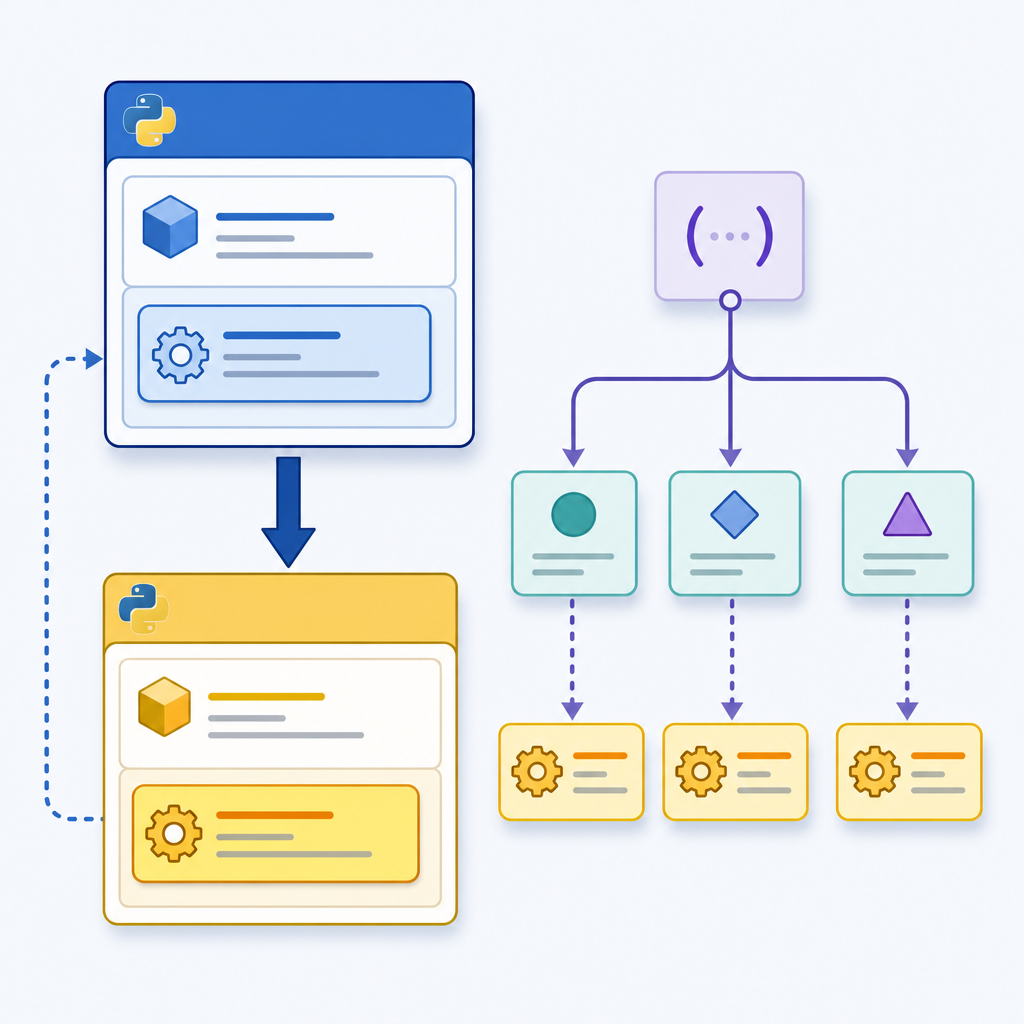
Method overriding in Python happens when a subclass defines a method with the same name as a method in its parent class (base class), providing a new implementation. When you call that method on a subclass instance, Python will use the subclass version first. This is a core part of Python OOP basics and makes inheritance flexible and powerful.
- Attribute lookup rule: Python looks for the method on the object’s class first, then walks up the inheritance chain following the method resolution order (MRO).
- Override vs extend: You can completely replace the parent method or extend it with
super(). - Common use: Customize or specialize behavior in child classes while reusing shared logic from the parent.
- A subclass method with the same name replaces the base method; Python follows the MRO for lookup.
- Use
super()to extend behavior so every class in the MRO can cooperate. - Keep parameters compatible with the parent method for predictable overrides.
- Special (dunder) methods are resolved on the class, not the instance.
Python method overriding with examples: the simplest case

Let’s start with a very simple example of overriding a parent class method in Python.
class Animal:
    def speak(self):
        return "Some generic animal sound"

class Dog(Animal):
    def speak(self):
        return "Woof!"

a = Animal()
d = Dog()

print(a.speak())
print(d.speak())Some generic animal sound
Woof!Because Dog overrides speak(), calling d.speak() uses the new implementation. This is the essence of method overriding in Python.
Why use overriding?
- Specialization: A subclass can customize how it behaves (e.g., a
Dogspeaks differently from a genericAnimal). - Reuse: Keep shared logic in the parent, override only what’s different in the child.
- Consistency: Create a common interface in the base class, ensure each subclass implements it in its own way.
Extending behavior with super() (not just replacing)
Often you don’t want to discard the parent’s work—you want to add to it. Use super() to call the parent method from inside the overriding method. The zero-argument form super() is the recommended Python 3 style.
from datetime class="cd-package">import datetime

class Logger:
    def log(self, message):
        print(f"[LOG] {message}")

class TimestampLogger(Logger):
    def log(self, message):
        # Extend: add a timestamp, then call the parent implementation
        now = datetime.now().isoformat(timespec="seconds")
        super().log(f"{now} - {message}")

t = TimestampLogger()
t.log("System started")[LOG] 2026-09-28T12:34:56 - System startedThis pattern is common when you want to override parent class methods but still leverage their original logic.
How method lookup works (MRO) in inheritance
Python uses the C3 linearization algorithm to determine the order in which classes are searched for attributes and methods. You can inspect it with Class.__mro__ or Class.mro().
class A:
    def who(self):
        return "A"

class B(A):
    def who(self):
        return "B"

class C(B, A):
    pass

c = C()
print(c.who())           # Resolved in B, before A
print(C.__mro__) # Shows the lookup orderB
(<class '__main__.C'>, <class '__main__.B'>, <class '__main__.A'>, <class 'object'>)Child(Left, Right):c.go() starts at Child. Child has no go, so Python checks next in the MRO.
Left.go() uses super(), control passes to the next class in the MRO.
super() forwards to Base.go(), continuing along the MRO.
super() means “call the next implementation in the MRO,” not “call my direct parent.”
In multiple inheritance scenarios, always prefer super() inside overriding methods so that all classes in the MRO can cooperate correctly.
Python method overriding example step by step
- Create a base class with a method.
- Inherit from the base class.
- Define a method with the same name in the subclass.
- Optionally call
super().method()to extend behavior.
class Shape:
    def area(self):
        # Default(not meaningful), but serves as a shared interface
        return 0

class Rectangle(Shape):
    def __init__(self, w, h):
        self.w = w
        self.h = h

    def area(self):
        # Override and compute actual area
        return self.w * self.h

rect = Rectangle(3, 4)
print(rect.area())12How to override __init__ in a Python class
Overriding __init__ is common when a subclass needs extra attributes. If the parent __init__ sets important attributes, call it via super().__init__() to ensure the object is properly initialized.
class User:
    def __init__(self, name):
        self.name = name

class Student(User):
    def __init__(self, name, grade):
        super().__init__(name)  # Call parent initializer
        self.grade = grade

s = Student("Anya", "A")
print(s.name, s.grade)Anya AIf you forget to call super().__init__() (and the parent defines critical setup), you may get missing attributes or errors later.
Overriding special (dunder) methods
Special methods like __str__, __len__, and __eq__ integrate your class with Python’s data model. Define them on the class to override behavior in a Pythonic way.
class Point:
    def __init__(self, x, y):
        self.x, self.y = x, y

    def __str__(self):
        return f"({self.x}, {self.y})"

p = Point(2, 5)
print(str(p))(2, 5)Note: Special method lookup checks the class, not the instance. Assigning p.__str__ = ... on the instance won’t affect str(p).
Multiple inheritance and cooperative overriding
In multiple inheritance, use super() to let each class in the chain contribute. Directly calling a specific parent’s method can break cooperative behavior.
class Base:
    def go(self):
        print("Base.go")

class Left(Base):
    def go(self):
        print("Left.go start")
        super().go()
        print("Left.go end")

class Right(Base):
    def go(self):
        print("Right.go start")
        super().go()
        print("Right.go end")

class Child(Left, Right):
    pass

c = Child()
c.go()
print([cls.__name__ for cls in Child.mro()])Left.go start
Right.go start
Base.go
Right.go end
Left.go end
['Child', 'Left', 'Right', 'Base', 'object']Each class uses super(), so calls flow through the full MRO.
Common mistakes when overriding (and how to fix them)
- Changing the method’s intended meaning or signature drastically, making subclasses hard to use consistently. Fix: Keep the same method name and compatible parameters.
- Forgetting
super()when the parent sets important state (especially in__init__). Fix: Callsuper().__init__(...)in the subclass. - Calling a specific parent directly in multiple inheritance (e.g.,
Parent.method(self)). Fix: Prefersuper()for cooperative MRO-aware calls. - Expecting runtime “overloading” by different parameter types or counts. Python doesn’t do that at runtime. Fix: Use default parameters,
*args/**kwargs, or type-checker-only@overloadannotations if you use typing. - Defining special methods on instances and expecting them to work. Fix: Define
__str__,__len__, etc., on the class.
Difference between method overriding and overloading in Python
These terms are easy to mix up. Here’s the short comparison:
| Concept | Method Overriding | Method Overloading |
|---|---|---|
| Where it happens | Between classes (subclass redefines parent method) | In the same class (same method name, different parameter lists) |
| Runtime behavior in Python | Supported directly via inheritance and MRO | Not supported by parameter types/count at runtime |
| Typical Python approach | Define the method in subclass; optionally use super() |
Use default args, *args/**kwargs, or @overload for type checkers only |
| Example | Dog.speak() replaces Animal.speak() |
One area() that accepts different kinds of inputs via optional args |
Modern tips: typing helpers for safer overriding
As you grow beyond the basics, type hinting can make overrides safer and clearer (checked by tools like mypy or pyright):
@typing.override(Python 3.12+): Marks that a method is intended to override a parent method. Type checkers can alert you if the parent has no such method or the signature is incompatible. It does not change runtime behavior.@typing.final(Python 3.8+): Mark a method or class that should not be overridden or subclassed. Enforced by type checkers.typing.Self(Python 3.11+): Annotate methods that return the current instance (useful for fluent APIs) so overrides remain type-accurate.
Practice: try a quick override yourself
- Create a base class
Vehiclewith amove()method returning a generic string. - Create subclasses
CarandBicyclethat overridemove(). - In one subclass, extend the behavior with
super()if you keep shared work in the base.
Small hands-on challenges like this build confidence with method overriding in Python for beginners.
FAQ: People also ask
What is method overriding in Python with a simple example?
It’s when a subclass provides a new implementation for a method defined in its parent. Example:
class Parent:
    def greet(self):
        return "Hello from Parent"

class Child(Parent):
    def greet(self):
        return "Hello from Child"

print(Child().greet())Hello from ChildHow do I override a method in Python step by step?
- Define the parent class and its method.
- Create a subclass inheriting from the parent.
- Define a method with the same name in the subclass.
- If needed, call
super().method()inside the subclass method to extend the parent’s behavior.
When should I use super() while overriding a method in Python?
Use super() when the parent class performs important work you still want to run—such as initializing attributes in __init__ or contributing part of a larger operation. In multiple inheritance, super() respects the MRO so all classes can cooperate.
Can we override __init__ in Python and how does it work?
Yes. Define __init__ in the subclass. If the parent __init__ sets necessary attributes, call super().__init__(...) to ensure proper initialization.
What is the difference between method overriding and overloading in Python?
Overriding replaces a parent method in a subclass at runtime (fully supported). Overloading by different parameter lists is not a runtime feature in Python; instead, use defaults, *args/**kwargs, or type-checker-only @overload hints.
Quick checklist before you ship
Related Python tutorials
Continue learning Python OOP basics, classes, and inheritance in our main Python path: CodDesire Python Tutorials.
Sources / Further reading
- Python Tutorial – Classes and Inheritance: docs.python.org
- Built-ins – super() and MRO: docs.python.org/builtins/super
- Data Model – Special method lookup: docs.python.org/reference/datamodel
- abc — Abstract Base Classes: docs.python.org/library/abc
- typing — Type Hints (3.12): docs.python.org/library/typing
- What’s New in Python 3.12 – PEP 698 (@override): docs.python.org/whatsnew/3.12 and PEP 698
- typing — Self type (3.11): docs.python.org/library/typing#Self