
If you’re learning C++ and building your first multi-file programs, you will quickly meet header files and “include guards.” This beginner-friendly guide explains C++ header files and include guards for beginners, why we use them, how to write them, and the small but important differences between classic include guards and #pragma once. By the end, you will know how to create your own headers, avoid common mistakes, and organize small school or college projects with confidence.
Explore more C++ tutorials on our hub: CodDesire C++ Tutorials.
Key takeaways: C++ header files and include guards for beginners
- Put declarations in headers and non-inline definitions in one
.cppfile. - Guard every project header with a unique macro or use
#pragma once(choose one). - Avoid reserved names: no leading underscores or double underscores in guard macros.
- Keep headers self-contained: each header should compile on its own when included into an empty file.
- Break circular includes with forward declarations where possible.
#define PROJECT_SUBDIR_FILENAME_H
// declarations…
#endif
What are header files in C++ and why do we use them?
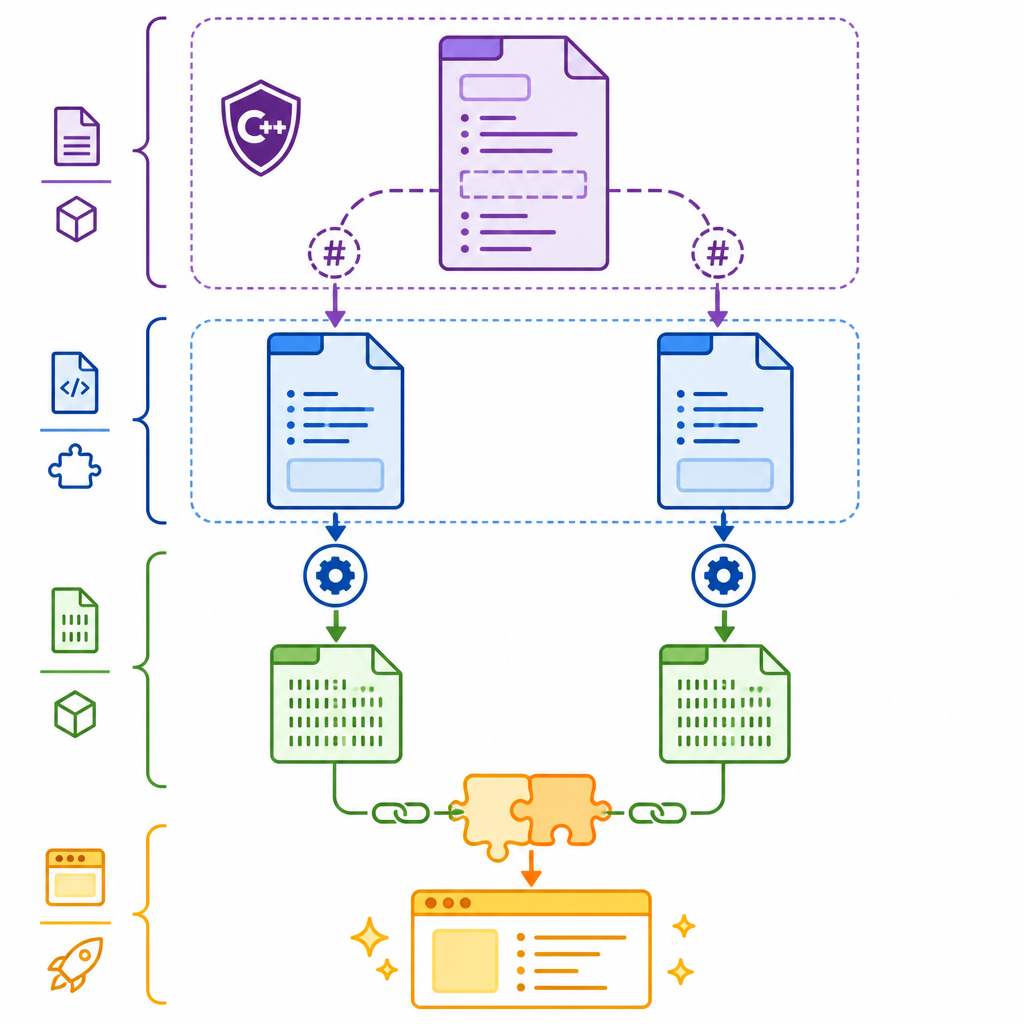
Header files in C++ are files that usually contain declarations: function declarations, class declarations, constants, type aliases, and templates. They help you separate interface from implementation, so your program is easier to read, test, and maintain. You include a header in any source file (.cpp) that needs those declarations using #include.
Typical practice:
- Put declarations in a header file (
.hor.hpp). - Put non-inline function definitions in a source file (
.cpp). - Include the header wherever you need the declarations.
This way, if you change the function’s implementation, you don’t have to edit every file that uses it—only the .cpp implementing it and, if needed, the header that declares it.
Why multiple inclusion is a problem

The #include directive copies the header’s text into your source file. If the same header is included more than once in a single translation unit (for example, directly and indirectly through another header), the compiler may see the same declarations or definitions twice. That can cause redefinition errors, longer compile times, and confusion.
To prevent this, we use include guards (or #pragma once) so that each header’s contents are processed only once per translation unit.
Include guards: syntax and working example
Include guards are simple macros that wrap the entire header. The first time the header is included, a macro is defined; the next time, the compiler sees the macro is already defined and skips the file.
Pattern
Place this pattern at the top and bottom of your header, using a unique macro name (avoid leading underscores):
// my_header.h
#ifndef CODDESIRE_MY_HEADER_H
#define CODDESIRE_MY_HEADER_H

// Declarations go here

#endif // CODDESIRE_MY_HEADER_H
Step-by-step guide to creating and including a header
Let’s build a tiny math library. We’ll create a header for declarations, a source file for implementations, and a main.cpp that uses them.
1) Header: math_utils.h (with include guard)
// math_utils.h
#ifndef CODDESIRE_MATH_UTILS_H
#define CODDESIRE_MATH_UTILS_H

int add(int a, int b);
double average(int a, int b);

#endif // CODDESIRE_MATH_UTILS_H
2) Source: math_utils.cpp
// math_utils.cpp
#class="cd-package">include "math_utils.h"

int add(int a, int b) {
    return a + b;
}

double average(int a, int b) {
    return (a + b) / 2.0;
}
3) Program that uses the header: main.cpp
// main.cpp
#class="cd-package">include <iostream>
#class="cd-package">include "math_utils.h"

int main() {
    std::cout << "Sum: " << add(7, 5) << "n";
    std::cout << "Average: " << average(7, 5) << "n";
    return 0;
}
Compile and run as a two-file program (example command): g++ main.cpp math_utils.cpp -o app, then run ./app
Sum: 12
Average: 6
How include guards work under the hood
Here is the logic the preprocessor follows for a guarded header like math_utils.h:
- Sees
#ifndef CODDESIRE_MATH_UTILS_H. If the macro doesn’t exist yet, it continues. - Defines the macro with
#defineand processes the header’s contents. - On any later inclusion into the same translation unit, the macro already exists, so the entire file is skipped.
Include guard flow (how the preprocessor sees it)
Tip: Choose a unique NAME like PROJECT_PATH_FILENAME_H (uppercase, underscores, no leading underscores).
Use a macro name that’s unique to your project and file (such as PROJECT_PATH_FILENAME_H). Avoid names with leading underscores or double underscores—they’re reserved by the implementation.
What happens if you forget include guards?
Consider a header without guards that defines a non-inline function:
// bad_math.h (intentionally wrong: no guard, definition in header, not inline)
int square(int x) { return x * x; }// main.cpp
#class="cd-package">include "bad_math.h"
#class="cd-package">include "bad_math.h" // accidental duplicate include
int main() {
return square(3);
}This can trigger a compile-time error like: redefinition of ‘int square(int)’. If the duplication happens across multiple source files, you could also get a link-time multiple definition error. Include guards (or #pragma once) prevent these issues in normal headers.
#pragma once vs include guards
#pragma once is a compact, widely supported (but non-standard) alternative that tells the compiler to include the file only once per translation unit. It goes at the very top of the header:
// math_utils.h (pragma once version)
#pragma once

int add(int a, int b);
double average(int a, int b);| Aspect | Include guards | #pragma once |
|---|---|---|
| Standard status | Fully standard C/C++ | Widely supported, non-standard |
| Syntax | Three lines: #ifndef / #define / #endif | One line at top of file |
| Uniqueness | Relies on a unique macro name | Relies on compiler detecting a unique file |
| Portability | Works everywhere | Supported by major compilers (GCC/Clang/MSVC) |
| Edge cases | None if macro is unique and legal | Rare path/aliasing issues in unusual setups |
| Performance | Modern compilers optimize this well | Also optimized; difference is negligible in practice |
Which should you choose? For maximum portability, include guards are always safe. If your toolchain supports it (most do), #pragma once is convenient and concise. There’s no need to use both together—mixing them provides no real benefit.
When not to guard a header
Some advanced patterns intentionally re-include a file to generate code (for example, the “X-macro” technique). Such files should not use include guards or #pragma once. As a beginner, you can ignore this until you encounter those patterns explicitly.
ODR tips: what belongs in headers vs .cpp files
The One Definition Rule (ODR) says that most non-inline functions and variables must have exactly one definition in the entire program. Practical tips:
- Put declarations in headers; put non-inline function definitions in exactly one
.cppfile. - Templates, inline functions, and inline variables (since C++17) must be defined in headers so all translation units can use them.
- Avoid defining the same non-inline function or non-inline global variable in multiple
.cppfiles.
How to organize C++ projects with header files
Simple and tidy layouts help beginners avoid include chaos:
- Folders: put public headers in
include/and implementations insrc/. - Naming: match header and source names, like
include/math_utils.handsrc/math_utils.cpp. - Self-contained headers: every header should compile on its own when included into an empty source file—include what you use inside the header.
- Use relative includes for your project headers with quotes:
#include "math_utils.h"; use angle brackets for library headers:#include <iostream>. - Avoid circular includes. If two headers refer to each other, consider forward declarations in one header and include the other header only in the
.cppfile.
Header hygiene checklist
- Use either include guards or
#pragma once—not both. - Create a unique guard macro:
PROJECT_SUBDIR_FILE_H(UPPERCASE, underscores, no leading underscores). - Put the guard at the very top; only comments may appear before it.
- Make headers self-contained: include what you use inside the header.
- Break cycles with forward declarations in headers; include full headers in
.cppwhen needed. - Put non-inline functions/variables in exactly one
.cppfile. - Keep templates, inline functions, and inline variables defined in headers.
- Use quotes for project headers (
#include "x.h") and angle brackets for library/system headers.
Common mistakes with C++ header files and include guards
- Forgetting guards or
#pragma once: leads to redefinition errors when the header is included twice. - Using reserved macro names: don’t start guard names with underscores or use double underscores.
- Defining non-inline functions in headers: causes multiple definitions at link time if included by multiple
.cppfiles. - Combining include guards and
#pragma once: unnecessary; pick one. - Order-dependent headers: if one header silently depends on another, include the dependency inside the header to keep it self-contained.
- Not using forward declarations: can cause circular includes. Forward declare classes when possible and include the full header only where needed.
Beginner tutorial on include guards in C++: quick recap
- Create a header (
.h) with a unique include guard macro around your declarations. - Implement non-inline functions in a
.cppthat includes the same header. - Include the header in any
.cppthat calls those functions. - Compile all relevant
.cppfiles together to create the program.
Modern note: C++20 modules and header units
Newer C++ standards introduce modules and header units to reduce textual inclusion, improve compile times, and avoid many dependency pitfalls. Many codebases still rely on classic headers and guards, and you will encounter them everywhere. If your compiler and libraries support modules, they’re worth exploring as you progress.
FAQ: quick answers
What is a header file in C++ and why do we use it?
A header file holds declarations (and sometimes inline definitions) that you want to share across source files. It keeps interfaces organized and avoids copying declarations into multiple .cpp files.
How do include guards work in C++?
They wrap a header with an #ifndef / #define / #endif macro sequence. On the first include, the macro is defined and the header’s contents are processed. On later includes in the same translation unit, the macro is already set, so the preprocessor skips the file.
Is pragma once better than include guards?
#pragma once is shorter and widely supported by major compilers, but it is non-standard. Include guards are fully standard and portable. In practice, both perform similarly on modern toolchains. Choose one approach consistently; don’t use both.
How do I create and include a header file in C++?
Create my_header.h with an include guard and your declarations, implement non-inline functions in my_source.cpp, and include the header where needed using #include "my_header.h". Compile all relevant .cpp files together.
What happens if I forget include guards in a header file?
If the header is included more than once in a translation unit, you can get redefinition errors and longer compile times. Use include guards or #pragma once to prevent this.
Practical mini-exercise
Try converting the earlier math_utils.h guard-based header to use #pragma once. Rebuild your project and verify the output remains the same. Then, intentionally remove the guard or #pragma once and include the header twice in main.cpp to observe the compiler error. This hands-on step makes the concept stick.
Summary and next steps
Headers let you share declarations cleanly; include guards (or #pragma once) ensure each header is processed only once per translation unit. Use unique, legal macro names for guards, keep headers self-contained, define non-inline functions in exactly one .cpp, and avoid mixing guard techniques. As you advance, explore C++20 modules, but expect to use classic headers throughout your learning journey.
Sources / Further reading
- GCC manual — Once-Only Headers: https://gcc.gnu.org/onlinedocs/cpp/Once-Only-Headers.html
- GCC manual —
#pragma once: https://gcc.gnu.org/onlinedocs/gcc-11.4.0/cpp/Pragmas.html - Microsoft Learn —
#pragma once: https://learn.microsoft.com/en-us/cpp/preprocessor/once?view=msvc-160 - cppreference — Modules (since C++20): https://en.cppreference.com/cpp/language/modules
- GCC — C++ Modules (header units): https://gcc.gnu.org/onlinedocs/gcc/C_002b_002b-Modules.html
- WG21 P2465R3 — Standard Library Modules std and std.compat: https://www.open-std.org/jtc1/sc22/wg21/docs/papers/2022/p2465r3.pdf
- libc++ — Modules in libc++ (C++23): https://libcxx.llvm.org/Modules.html