
Technology
Machine Learning vs Deep Learning vs Neural Networks - A Visual Comparison with Real Applications
Introduction
Artificial Intelligence (AI) has become a key driver of innovation across industries – from healthcare and finance to entertainment and autonomous systems.
But within AI, you often hear three terms used interchangeably: Machine Learning (ML), Deep Learning (DL), and Neural Networks (NN).
Though closely related, they are not the same.
Let’s break down their differences, relationships, and real-world applications – visually and simply.
1. Artificial Intelligence: The Bigger Picture
AI is the broad field that focuses on making machines “think” and “act” intelligently — similar to humans.
AI includes:
Rule-based systems (like chatbots following if-then logic)
Machine Learning (learning from data)
Deep Learning (advanced learning through neural networks)
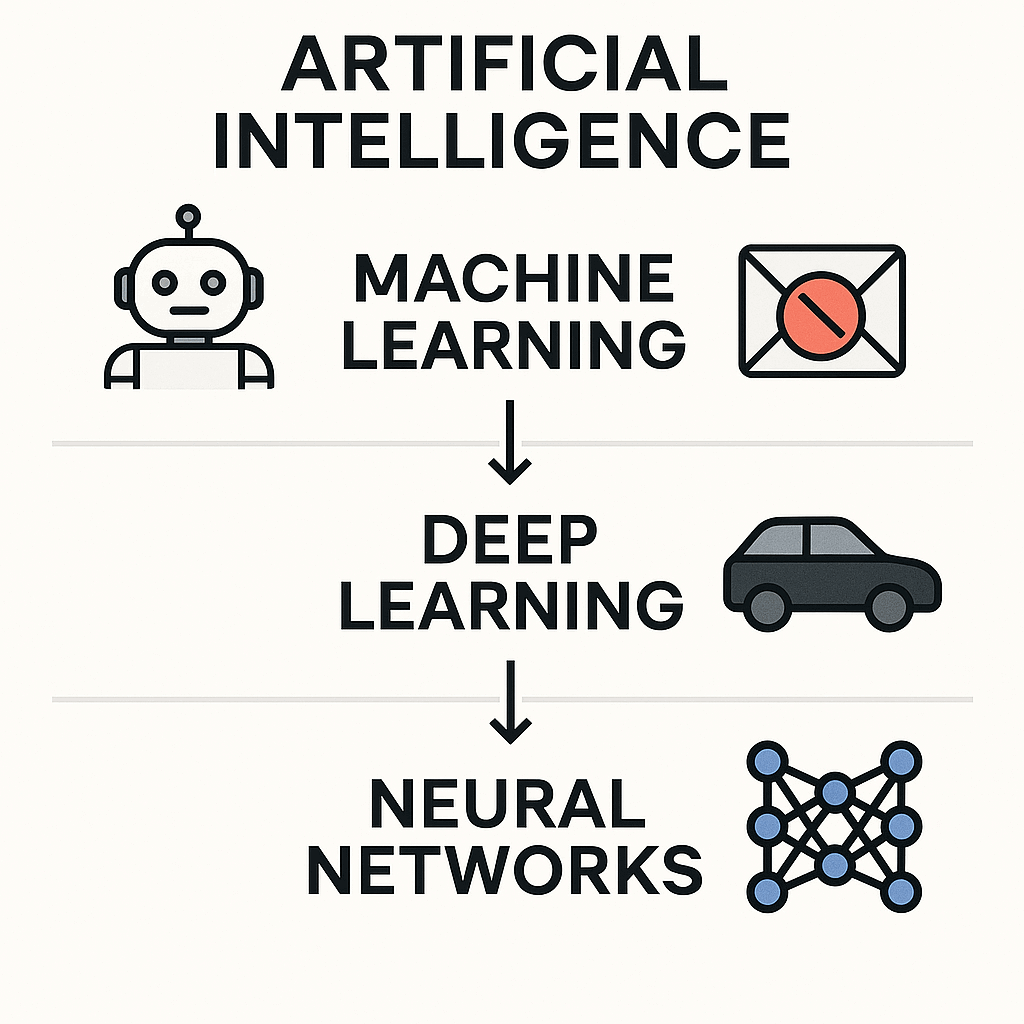
Visual hierarchy:
AI ⟶ Machine Learning ⟶ Deep Learning ⟶ Neural Networks
2. What is Machine Learning (ML)?
Machine Learning is a subset of AI that enables systems to learn from data and improve automatically without being explicitly programmed.
How it works:
You feed the system lots of data.
The algorithm finds patterns.
It uses those patterns to make predictions or decisions.
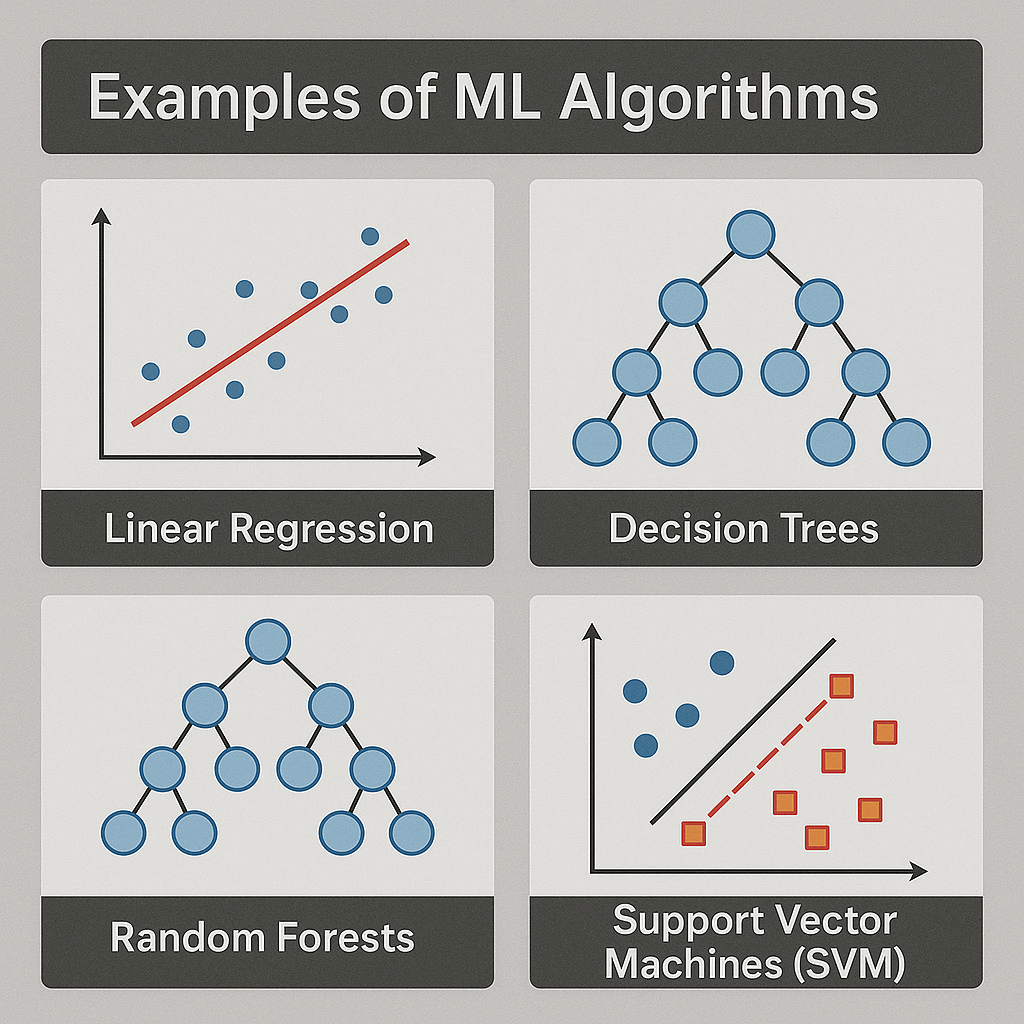
Examples of ML algorithms:
Linear Regression
Decision Trees
Random Forests
Support Vector Machines (SVM)
Real-world applications:
Email spam detection (Spam vs. Not Spam)
Credit card fraud detection
Recommendation systems (Netflix, Amazon)
Weather prediction

3. What is Deep Learning (DL)?
Deep Learning is a specialized branch of Machine Learning that uses multi-layered neural networks to analyze complex data.
It doesn’t require manual feature extraction – the network learns features automatically from raw data.
How it works:
Data passes through multiple layers of artificial neurons.
Each layer extracts increasingly abstract features.
The final layer outputs predictions.
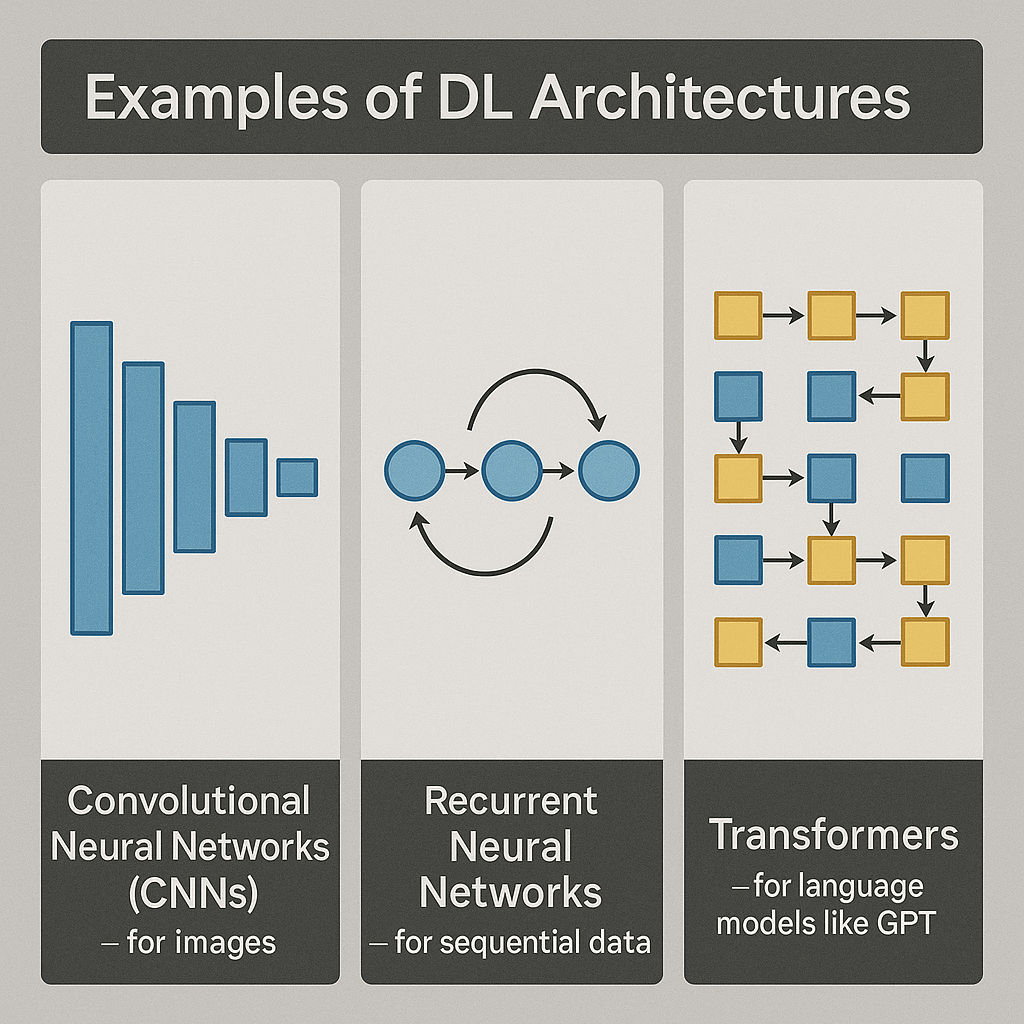
Examples of DL architectures:
Convolutional Neural Networks (CNNs) – for images
Recurrent Neural Networks (RNNs) – for sequential data
Transformers – for language models like GPT
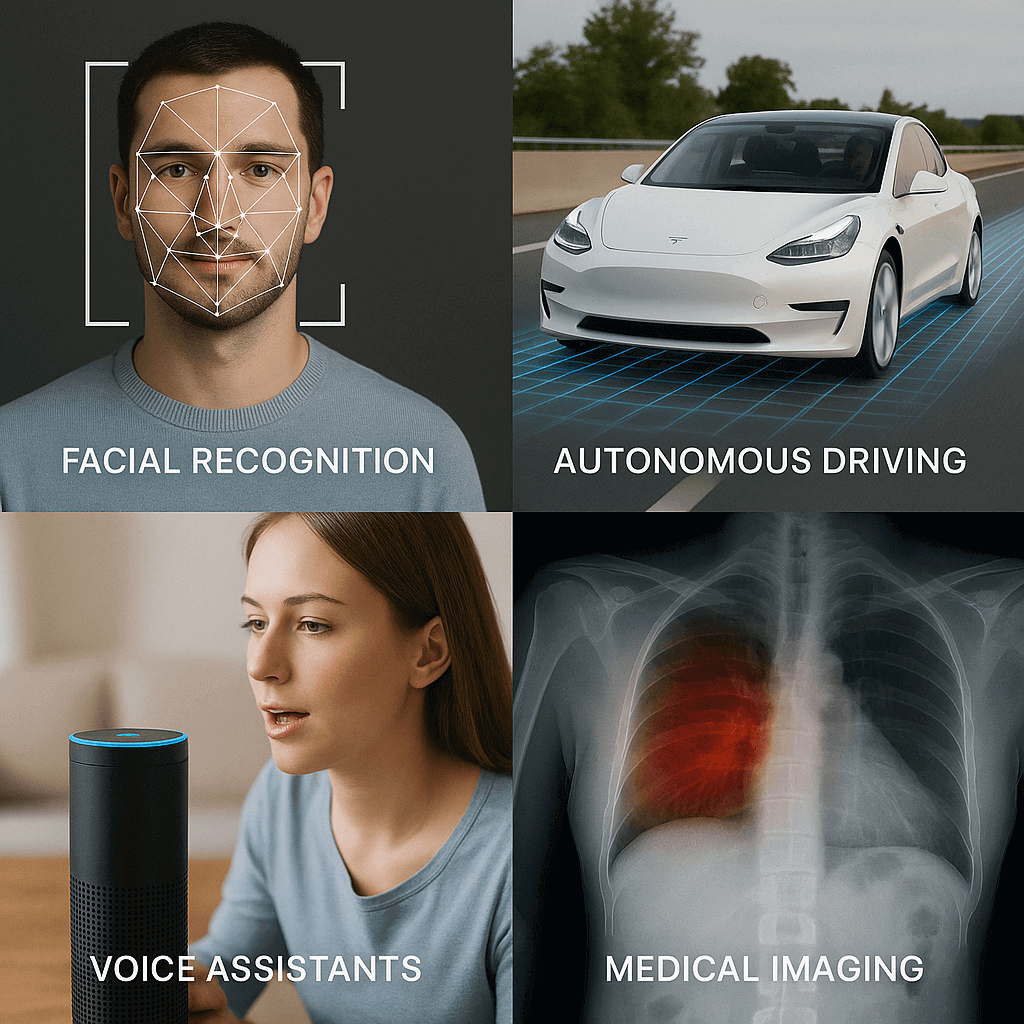
Real-world applications:
Facial recognition (e.g., Face ID)
Autonomous driving (Tesla Autopilot)
Voice assistants (Siri, Alexa, Google Assistant)
Medical imaging (cancer or X-ray detection)
4. What Are Neural Networks (NN)?
Neural Networks are the building blocks of Deep Learning – inspired by how the human brain works.
A neural network consists of:
Input layer: Takes in raw data (like images, text, or numbers)
Hidden layers: Process data and detect patterns
Output layer: Produces the result (like “cat” or “dog”)
Each connection (called a neuron) has a weight and activation function, determining how much influence one neuron has on another.
Simple example:
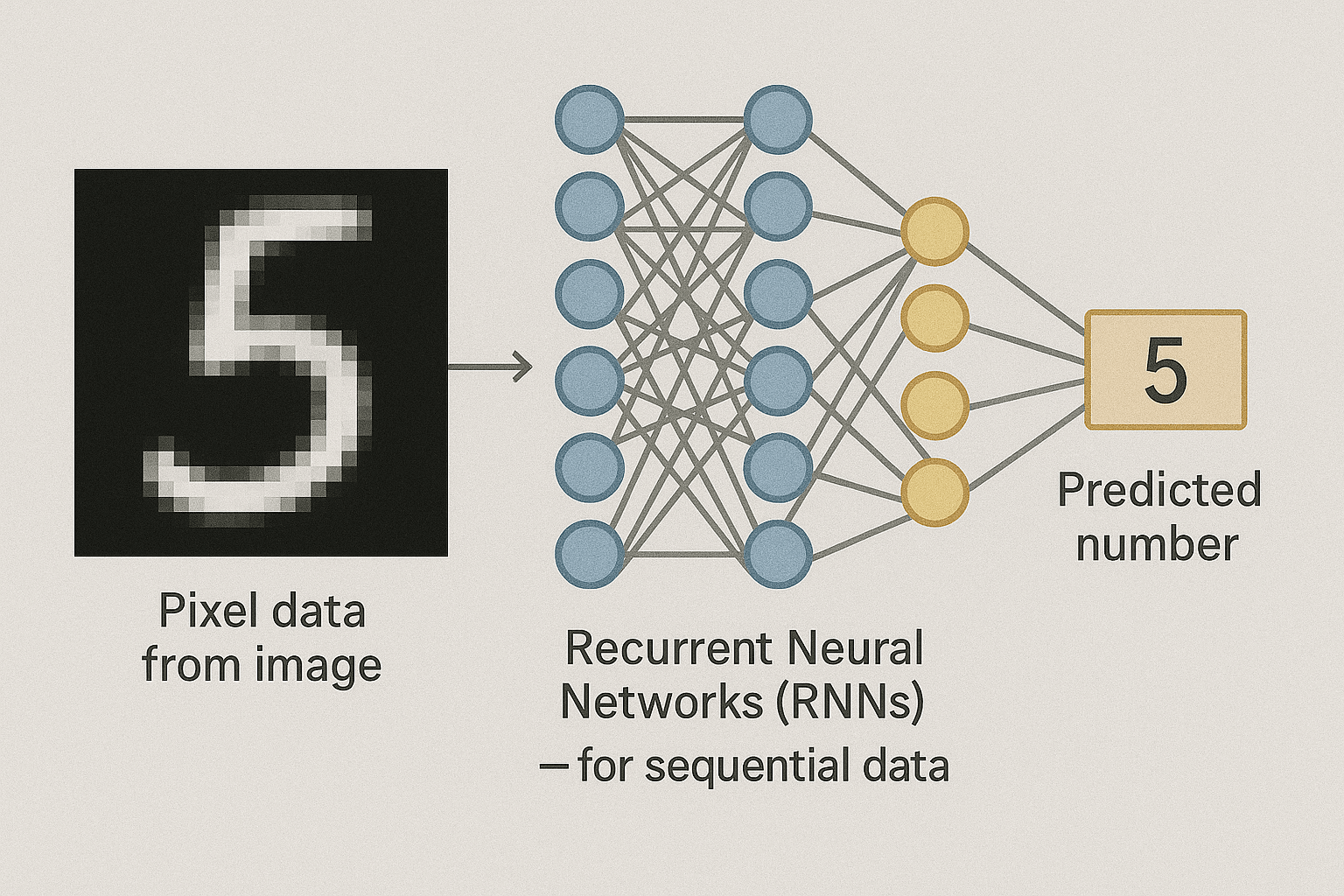
A neural network trained to recognize handwritten digits (0–9) can take pixel data from images and predict which number it represents.
5. Key Differences at a Glance
| Feature | Machine Learning | Deep Learning | Neural Networks |
|---|---|---|---|
| Definition | AI systems that learn from data | Subset of ML using layered networks | Computational models mimicking brain neurons |
| Data Requirement | Works well with small datasets | Needs large amounts of data | Depends on layers & connections |
| Feature Engineering | Manual | Automatic | Automatic (via layers) |
| Hardware Need | CPU | GPU/TPU | GPU/TPU |
| Examples | Spam filters, Price predictions | Image/Voice recognition | Handwriting recognition |
| Training Time | Short | Long | Varies |
| Interpretability | Easy to explain | Harder to explain | Moderate |
6. Real-World Examples by Category
| Domain | Machine Learning | Deep Learning / Neural Networks |
|---|---|---|
| Healthcare | Disease risk prediction | MRI & CT scan image recognition |
| Finance | Credit scoring | Algorithmic trading |
| Retail | Customer segmentation | Visual product search |
| Transportation | Route optimization | Self-driving perception systems |
| Entertainment | Recommendation engines | Deepfake video generation |
| Agriculture | Crop yield prediction | Drone image analysis for pests |
7. Relationship Between ML, DL & NN (Visual)
Artificial Intelligence
│
├── Machine Learning
│     ├── Supervised Learning
│     ├── Unsupervised Learning
│     └── Reinforcement Learning
│
└── Deep Learning
      └── Neural Networks
            ├── CNN (for images)
            ├── RNN (for sequences)
            └── Transformers (for language)
8. Example from Everyday Life
Let’s say you want to build a self-driving car:
AI: Enables the car to make decisions like a human driver.
Machine Learning: Learns from past driving data (brake, steer, accelerate).
Deep Learning: Uses neural networks to recognize objects, lanes, and pedestrians from camera input.
Neural Networks: Perform the actual image and sensor interpretation in real-time.
9. Future Outlook
As computation and data continue to grow, Deep Learning and Neural Networks will dominate new applications – from AI-generated art to autonomous robotics and quantum-enhanced ML.
Yet, traditional Machine Learning will remain critical for smaller, explainable, and efficient systems.
Conclusion
Machine Learning, Deep Learning, and Neural Networks are not rivals – they’re evolutionary stages of the same journey toward intelligent systems.
Machine Learning helps machines learn patterns.
Deep Learning gives them perception.
Neural Networks provide the foundation for both.
Understanding their connection helps you choose the right tool for your AI project – whether it’s a simple prediction model or a complex vision system.