Python has become the go-to programming language for data science and machine learning, thanks in large part to its comprehensive ecosystem of libraries tailored for various stages of data analysis and model building. Whether you’re a student just starting out, a blogger wanting to explore data insights, a small business owner tackling analytics, or a developer diving into machine learning, understanding essential Python libraries for data science can significantly accelerate your projects.
Why Choose Python for Data Science?
Python’s versatility and simplicity make it ideal for beginners and experts alike. Its libraries reduce complex tasks into manageable functions, allowing you to focus on the insights rather than reinventing the wheel. As of 2026, Python continues evolving with upgraded libraries that offer better speed, usability, and integration for both data analysis and machine learning workflows.
Top Essential Python Libraries for Data Science
1. NumPy
NumPy is the foundational library for numerical computing in Python. It provides support for arrays, matrices, and mathematical functions to process large datasets efficiently.
What’s new? NumPy 2.0 introduces significant performance improvements that enhance computational efficiency, especially when handling large datasets.
Example use: Creating and manipulating arrays:
import numpy as np
arr = np.array([1, 2, 3, 4])
print(arr.mean())  # Outputs the average
2. pandas
The pandas library specializes in data manipulation and analysis, offering powerful data structures like DataFrames that make handling tabular data simple and efficient.
Recent updates: pandas 3.0 accelerates data wrangling tasks with faster processing times, making your workflows smoother.
Example use: Loading and exploring a dataset:
import pandas as pd
df = pd.read_csv('data.csv')  # Load CSV data
print(df.head())  # Display first 5 rows
3. scikit-learn
For machine learning in Python, scikit-learn remains a popular choice due to its wide range of simple and effective algorithms for classification, regression, clustering, and more.
As of 2026: scikit-learn 2.0 simplifies the machine learning workflow, making it more accessible for beginners and speeding up model experimentation.
Example use: Training a simple model:
from sklearn.linear_model import LogisticRegression
model = LogisticRegression()
model.fit(X_train, y_train)  # Train model
predictions = model.predict(X_test)  # Make predictions
4. TensorFlow and PyTorch
For deep learning tasks, TensorFlow and PyTorch dominate as the best Python libraries for machine learning. These libraries allow you to build complex neural networks for advanced AI applications.
- TensorFlow 2.18: Focuses on streamlining model deployment, improving scalability, and integrating smoothly with production systems.
- PyTorch 3.0: Provides advanced features that facilitate the creation of complex architectures and dynamic computation graphs.
Practical tip: Beginners may start with tutorials focusing on pre-built models available on platforms like NexusAI by CodDesire to get hands-on experience.
5. River
A newcomer gaining traction is the River library, ideal for machine learning on streaming data. Its state-of-the-art methods and performance metrics allow real-time learning and adaptation, critical for evolving datasets.
Mastering essential Python libraries for data science empowers you to handle everything from data preparation to deployment efficiently. Starting with core libraries like NumPy and pandas provides a strong foundation, while scaffolding on scikit-learn, TensorFlow, and River unlocks advanced machine learning capabilities.
Beginner Friendly Python Libraries for Data Science
If you are new to Python and data science, start with libraries that have clear documentation and lots of community support:
- pandas: to handle and analyze tabular data easily.
- matplotlib & seaborn: for data visualization.
- scikit-learn: to learn machine learning basics with simple APIs.
Many online resources, including books listed at CodDesire Books, cover these libraries in detail for beginners.
Python Machine Learning Workflow Overview
How to Use Python Libraries for Machine Learning
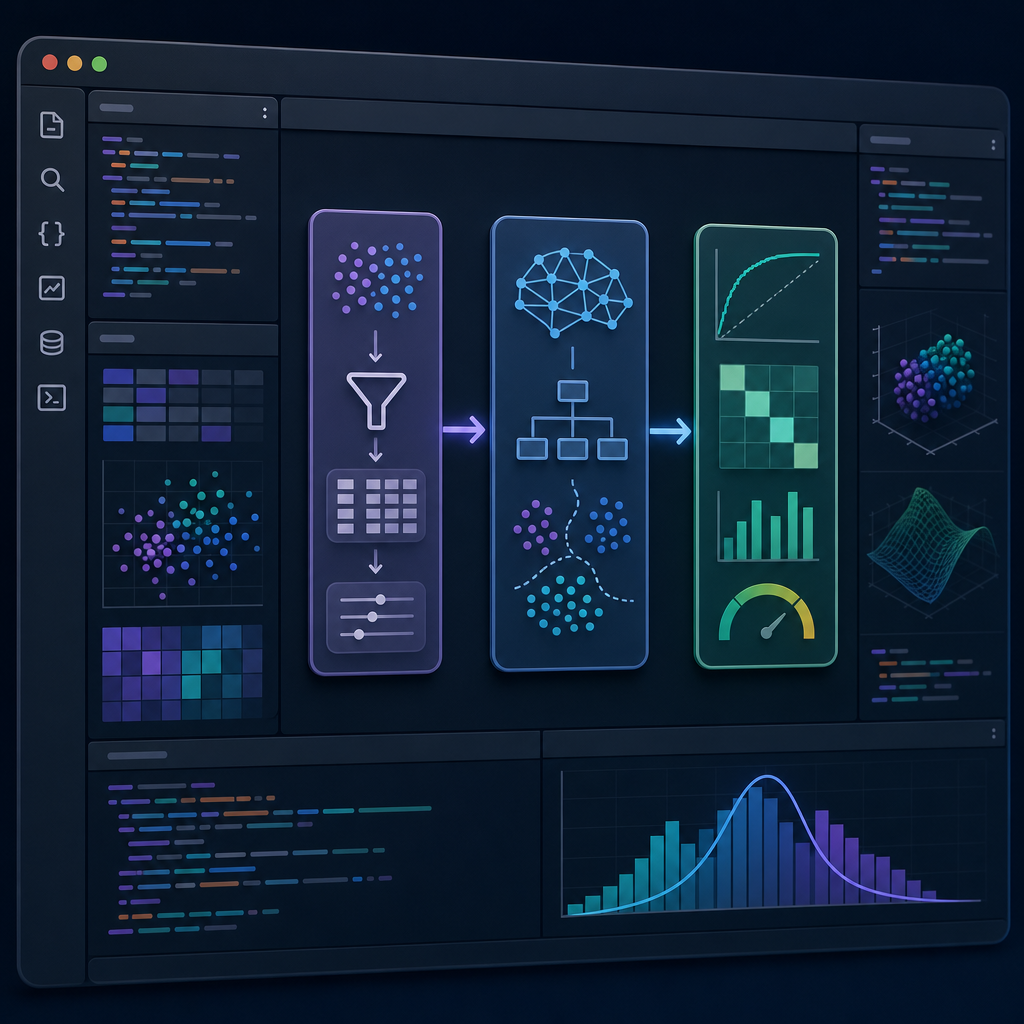
To effectively use machine learning Python libraries, follow this general workflow:
- Data Preparation: Use pandas and NumPy to clean and prepare your datasets.
- Feature Engineering: Create or select meaningful features for your models.
- Model Training: Apply algorithms with scikit-learn or deep learning models in TensorFlow/PyTorch.
- Evaluation: Test your model’s performance using metrics like accuracy or precision.
- Deployment: Utilize TensorFlow’s deployment tools or export models for real-world applications.
This approach helps make machine learning projects manageable, even for beginners.
Relative Popularity of Essential Python Libraries
Python Libraries for Small Business Data Projects
Small business owners looking to leverage data analytics can benefit greatly from Python data science libraries. Tools like pandas for data handling, matplotlib and seaborn for visualization, and scikit-learn for predictive insights provide an affordable and powerful analytics platform.
Using these python libraries for small business data projects enables owners to:
- Analyze customer behavior
- Forecast sales
- Optimize marketing campaigns
The flexibility and scalability of Python libraries help even small teams manage and gain insights from data with minimal investment.
Step-by-Step Checklist for Small Business Python Data Projects
- Collect and organize your business data in CSV or Excel files.
- Use pandas to clean and preprocess data for accuracy.
- Visualize trends and patterns with matplotlib and seaborn.
- Predict outcomes such as sales or customer churn using scikit-learn.
- Regularly update models with new data for improved insights.
- Leverage simple Python scripts to automate routine analytics tasks.
Frequently Asked Questions
What are the best Python libraries for data science?
Some of the best python data science libraries include NumPy, pandas, scikit-learn, TensorFlow, PyTorch, and River. These libraries cover data processing, analysis, and machine learning.
Which Python libraries are used for machine learning?
Popular machine learning Python libraries are scikit-learn for conventional algorithms, TensorFlow and PyTorch for deep learning, and River for streaming data.
How can beginners start using Python for data science?
Beginners should start with pandas and NumPy for data manipulation, matplotlib/seaborn for visualization, and use scikit-learn to learn basic machine learning concepts. There are many tutorials and resources available, including books on CodDesire.com.
What Python libraries are good for small business analytics?
Small businesses can effectively use pandas for data handling, matplotlib/seaborn for visualization, and scikit-learn for predictive analytics and insights to drive better business decisions.